Simplify Your Multifamily Tech Stack in 2026
If it takes seven logins to answer one resident question, your software isn’t helping—it’s slowing you down.
Most multifamily teams don’t have a technology problem. They have a too-much-technology problem.
This guide walks through how to simplify your multifamily tech stack, where AI and automation actually save time (not add noise), and which smart apartment upgrades genuinely improve the resident experience heading into 2026.
The “Too Many Logins” Problem Is Real
A resident calls about a work order.
The balance is in one system.
Messages live somewhere else.
Maintenance notes are… not where you thought.
That’s how you end up with scattered answers, frustrated staff, and residents who feel bounced around. When systems don’t talk to each other, technology creates friction instead of removing it.
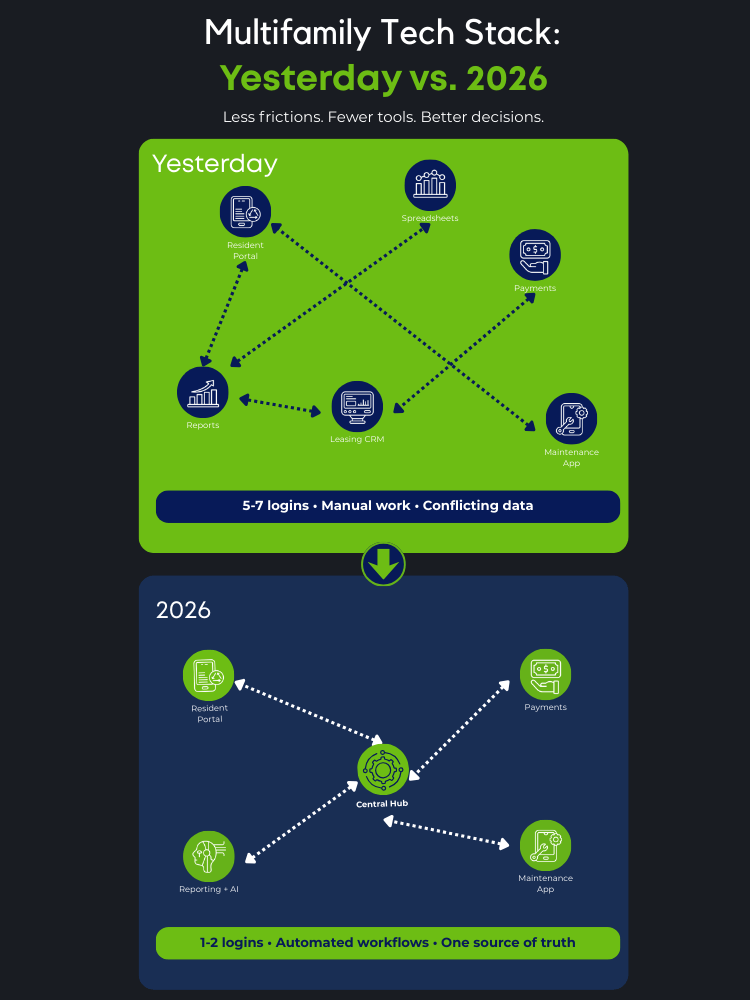
The goal for 2026 isn’t more tools. It’s fewer tools that work together, supported by automation where it actually helps.
Simplify Your Multifamily Tech Stack (Without Starting Over)
For years, the default approach was simple: identify a problem, buy a tool.
Online applications.
Leasing CRM.
Resident portal.
Maintenance platform.
Analytics dashboard.
Individually, each tool made sense. Together, they created a maze.
What a simplified stack looks like in 2026
Most successful operators are moving toward the same model:
-
One core platform (your PMS) as the hub
-
A short list of add-ons that integrate cleanly
-
Automation for repeatable tasks, not edge cases
The payoff isn’t flashy technology. It’s clarity—one source of truth, fewer handoffs, and less rework.
What consolidation looks like in practice
These are illustrative, but common:
-
A mid-size property replaces separate leasing, portal, and maintenance tools with one integrated setup—resulting in one resident profile and fewer mistakes.
-
A regional owner adopts a simple rule: no new software unless it integrates with the PMS. Tool sprawl stops almost overnight.
A quick tech stack audit (15 minutes)
Ask your team:
-
How many logins do we use daily?
-
Which tools don’t integrate with the core system?
-
Where are we still retyping or exporting data?
-
What frustrates residents most—payments, maintenance, communication, renewals?
-
Who owns each tool after launch?
If there’s no clear owner, the tool will quietly fail—even if it’s well-designed.
Where AI and Automation Actually Help
In 2026, AI isn’t a novelty feature. It’s becoming infrastructure—quietly embedded into leasing, maintenance, and resident communication.
The key question isn’t “Should we use AI?”
It’s “Where does it remove friction?”
Leasing: faster responses, better follow-up
AI helps most where volume and speed matter:
-
Answering common questions after hours
-
Routing and prioritizing leads
-
Scheduling tours automatically
The result isn’t fewer leasing agents—it’s fewer missed opportunities.
Maintenance: smarter triage, fewer repeat trips
Automation works well here because the workflows repeat:
-
Categorizing work orders
-
Flagging urgent issues
-
Improving routing and vendor planning
Even small efficiencies compound during peak seasons.
Resident communication: fewer blasts, better timing
AI-supported platforms can segment messages so residents receive relevant reminders instead of generic emails they ignore.
Digital convenience matters. Most renters now expect to pay rent, submit maintenance, and communicate online. AI simply helps those systems run smoother.
How to pilot AI without overwhelming staff
Keep it simple:
-
Start with one workflow
-
Define success in plain language
-
Train staff like it’s a new teammate
-
Keep human oversight for sensitive issues
If staff trusts the tool, adoption follows.
Smart Apartment Tech That Actually Improves the Experience
Smart apartment tech has shifted from “nice-to-have” to baseline—when it solves real problems.
The practical starter pack
These upgrades tend to deliver real value:
-
Smart locks and access control
Easier self-guided tours, fewer key issues. -
Smart thermostats and leak detection
Comfort, risk reduction, and operational savings. -
One resident portal that works
Payments, maintenance, and messaging in one place.
If residents juggle multiple portals, they’ll stop using all of them.
A quick warning
If your basics aren’t solid—clear workflows, assigned ownership, consistent support—smart devices become one more thing to manage instead of a solution.
Local Insight for Lubbock Operators
Lubbock properties often run lean. Busy season hits fast—especially with student turns tied to Texas Tech.
That’s why the biggest tech wins here aren’t flashy. They’re practical:
-
One place to find accurate answers
-
Fewer handoffs between systems
-
Faster responses for residents
-
Less burnout for onsite teams
Strong digital presentation matters too. Tools like accurate pricing, updated photos, and virtual tours help renters make confident decisions before they ever step onsite.
Conclusion: Keep It Simple, Keep It Useful
You don’t need 25 tools to run a great property in 2026.
You need:
-
A simplified tech stack
-
Automation in the right places
-
Smart upgrades that reduce friction
This week’s action:
Audit your stack. Count logins. List tools. Pick one workflow to improve.
Small wins add up fast.